
IV Ketamine for
Anxiety
Your brain wasn't built to run at full speed all the time. Ketamine can help quiet the noise and restore the calm you've been missing.
Start with a simple conversation. No pressure — just clarity.Your brain wasn't built to run at full speed all the time. Ketamine can help quiet the noise and restore the calm you've been missing.
Start with a simple conversation. No pressure — just clarity.Everyone experiences anxiety. It is a normal, healthy response to genuine threat. But for the 40 million Americans living with an anxiety disorder, the alarm system never fully turns off. The worry is constant, the tension is physical, and the fear feels disproportionate to anything happening in the real world.
Generalized anxiety disorder fills your days with a low-grade dread that something terrible is about to happen. Social anxiety makes every interaction feel like an audition you're bound to fail. Treatment-resistant anxiety means you've tried the standard medications — the SSRIs, the benzodiazepines, the therapy protocols — and you're still white-knuckling through your days.
If this sounds familiar, ketamine may offer a fundamentally different kind of relief.
At the center of anxiety is a brain region network called the default mode network (DMN) — the part of your brain responsible for self-referential thinking, rumination, and mental time travel. In people with anxiety disorders, the DMN runs hot. It replays past mistakes, catastrophizes about the future, and generates the relentless inner monologue that keeps you trapped in worry.
Neuroimaging studies show that ketamine temporarily quiets the default mode network, creating a window where the brain can reset its baseline activity. Think of it like rebooting an overloaded computer. The intrusive thought loops pause. The mental chatter dims. And in that quiet space, your brain has the opportunity to form new, healthier patterns of neural communication.
Anxiety is also linked to an imbalance in the glutamate system — too much excitatory signaling, not enough inhibitory regulation. Ketamine's NMDA receptor blockade helps restore this balance, reducing the neural hyperexcitability that drives anxiety symptoms. Unlike benzodiazepines, which simply sedate the nervous system, ketamine addresses the root circuitry dysfunction.
The anti-anxiety effects of ketamine are distinct from sedation. Patients don't report feeling numbed or foggy after treatment. Instead, they describe a clarity — a sense that the volume on their worry has been turned down and they can finally think straight. For many, it is the first time in years they have experienced what a quiet mind actually feels like.
Many patients describe a window after treatment where the brain feels more open to change.
The hallmark of GAD is persistent, excessive worry about everyday things — health, finances, work, relationships — that is difficult to control and out of proportion to the actual situation. Ketamine's ability to disrupt rumination circuits makes it particularly effective for GAD patients who have not responded to first-line treatments.
Social anxiety goes far beyond shyness. It is an intense fear of being judged, embarrassed, or humiliated that can make ordinary interactions feel unbearable. Research suggests ketamine promotes cognitive flexibility — the ability to reframe negative self-beliefs — which is at the core of social anxiety recovery.
If you have tried two or more medications without adequate relief, your anxiety may be classified as treatment-resistant. This does not mean you are beyond help. It means the standard approach is not reaching the neural pathways that drive your symptoms. Ketamine works through an entirely different mechanism — the glutamate pathway — which is why it can succeed where other treatments have not.
I had been dealing with generalized anxiety and migraines for over a decade. I tried everything — therapy, medication, meditation apps, supplements. Some helped a little. Nothing lasted. Marla made me feel safe from the very first consultation, and the infusions were nothing like I expected.
By the third infusion, the constant background hum of worry had genuinely faded. My migraines became less frequent too. I sleep through the night now. I cannot overstate what a difference this has made in my life.
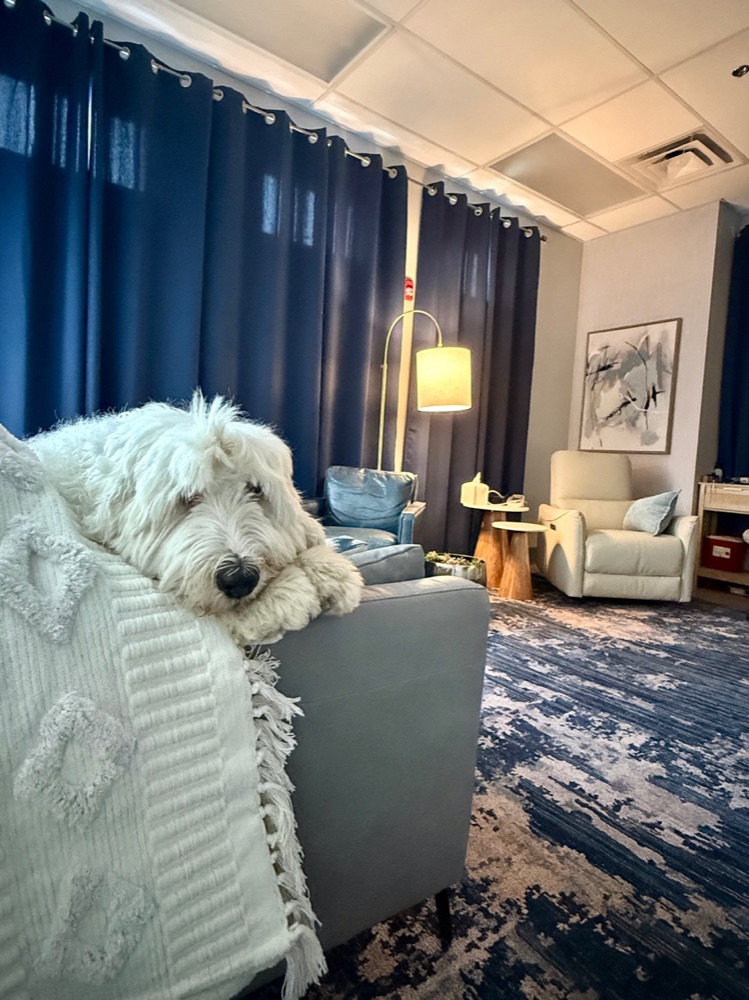
We understand that seeking treatment for anxiety can itself feel anxiety-provoking. That is why every aspect of your experience at Music City Ketamine has been designed with your comfort in mind.
Your treatment begins with a thorough consultation — a conversation, not an interrogation — where Marla reviews your history, answers your questions, and determines whether ketamine therapy is appropriate for you. There is never any pressure to proceed.
If ketamine is a good fit, you will typically complete a series of six infusions over two to three weeks. The infusion runs about 40 minutes, but plan on about an hour total from start to finish. You will be in a private suite with continuous monitoring throughout. Many patients with anxiety find the infusion experience itself to be profoundly calming — a welcome contrast to their daily reality.
Our therapy dogs, Walter White and Wilma, are often around the clinic too. There is something about a dog's presence that anxiety cannot fully argue with.
A free phone consultation is all it takes to find out if ketamine therapy can help quiet your anxiety. No pressure. No obligation. Just a conversation.
No pressure — just clarity.
Start with a simple conversation. No pressure — just clarity.Or call us directly: (615) 988-4600
Monday – Friday 8am–5pm • Weekends 9am–5pm